Threat reportRansomwareTL-2026-6610
Barracuda Ransomware Group Claims Dallas Theological Seminary (dts.edu) – 519 GB Data Leak
The Barracuda ransomware/extortion group listed Dallas Theological Seminary (US, Education) on its leak site on 2026-11-20, claiming 519 GB of stolen data published for free after the organization allegedly refused to cooperate. The claim is unverified; no CVE, malware or intrusion method is stated in the sources.
Key facts
| Identifiers | TL-2026-6610 |
|---|---|
| Severity | HIGH |
| Affected products | Dallas Theological Seminary Organization IT environment (dts.edu) – claimed compromise, unverified |
| Attribution | Barracuda ransomware group (low confidence) |
| Malware | Dataleak |
| MITRE ATT&CK techniques | T1005 Data from Local System, T1078 Valid Accounts, T1190 Exploit Public-Facing Application, T1567 Exfiltration Over Web Service, T1657 Financial Theft |
| Motivation | FINANCIAL |
| Target sectors | education, technology, manufacturing, health, transport, finance, government administration |
| Target regions | North America, Europe, Asia, 005 - South America |
| Detection rules | 9 (1 shown free) |
| Sources | 8 cited sources |
Detection coverage
As of 2026-11-20, Threadlinqs Intelligence publishes 9 detection rule(s) for TL-2026-6610 across Splunk SPL, Microsoft KQL and Sigma, covering 11 indicator(s) of compromise. The whole corpus is readable without an account. Every threat comes with one complete detection in Splunk SPL, Microsoft KQL and Sigma, free for everyone; a free account adds daily TL Creds to unlock the rest. Paid plans add a larger daily allowance, correlation and the MCP server. Threadlinqs MCP server · View plans.
Free detection: TL-2026-6610 Barracuda - Entra ID Password Spray / Brute Force Followed by Successful Sign-in (T1078)
Detects a single source IP generating many failed Entra ID (Microsoft 365) sign-ins across multiple accounts followed by at least one success. Exposure telemetry for dts.edu (HudsonRock/ParanoidLab) shows leaked credentials, so valid-account abuse (T1078) is the most plausible access path for the Barracuda group claim; the group itself names no exploit. Behaviour-first, no IOC dependency.
- Languages: Splunk SPL, Microsoft KQL, Sigma
- ATT&CK: T1078, T1078.004, T1110.003
- Data sources: azure:monitor:aad (index=azure), SigninLogs
- Severity: high
- Confidence: medium
Splunk SPL
index=azure sourcetype="azure:monitor:aad" category=SignInLogs earliest=-24h
| eval user='properties.userPrincipalName', src='properties.ipAddress', err='properties.status.errorCode'
| eval outcome=if(err=0,"success","fail")
| stats count(eval(outcome="fail")) as failures count(eval(outcome="success")) as successes dc(user) as distinct_users values(user) as users min(_time) as first_seen max(_time) as last_seen by src
| where failures>=15 AND successes>=1 AND distinct_users>=3
| convert ctime(first_seen) ctime(last_seen)
| sort - failures
Microsoft KQL
SigninLogs
| where TimeGenerated > ago(24h)
| summarize Failures=countif(ResultType in ("50126","50053","50057")), Successes=countif(ResultType == "0"),
            DistinctUsers=dcount(UserPrincipalName), Users=make_set(UserPrincipalName, 25),
            FirstSeen=min(TimeGenerated), LastSeen=max(TimeGenerated) by IPAddress
| where Failures >= 15 and Successes >= 1 and DistinctUsers >= 3
| project FirstSeen, LastSeen, IPAddress, Failures, Successes, DistinctUsers, Users
| order by Failures desc
Sigma
title: Entra ID Smart Lockout Indicating Password Spray (Barracuda TL-2026-6610)
id: 6b1f0c3e-4a52-4d7a-9c11-2e5a7d3b8a01
status: experimental
description: Entra ID sign-in failures with error 50053 (account locked by smart lockout) which commonly follow password spraying or credential stuffing against valid accounts. Correlate with later successes from the same IP.
references:
    - https://www.ransomware.live/group/Barracuda
    - https://www.ransomware.live/id/RGFsbGFzIFRoZW9sb2dpY2FsIFNlbWluYXJ5QEJhcnJhY3VkYQ
author: Threadlinqs Team
date: 2026-11-20
tags:
    - attack.initial-access
    - attack.credential-access
    - attack.t1078.004
    - attack.t1110.003
logsource:
    product: azure
    service: signinlogs
detection:
    selection:
        ResultType: '50053'
    condition: selection
falsepositives:
    - Users repeatedly mistyping passwords
    - Misconfigured service accounts or legacy clients with stale credentials
level: medium
Known false positives:
- Users repeatedly mistyping passwords after a rotation
- Legacy mail clients or service accounts holding stale credentials
- Shared egress IP (campus NAT) aggregating many students
Tuning notes: Raise failures threshold for campus/NAT egress ranges, exclude known scanner IPs, and enrich with Conditional Access named locations. Prioritise accounts present in infostealer exposure lists.
- TL-2026-6610 Barracuda - Same-User Successful Sign-ins from Multiple Countries Within 1 Hour (T1539 / T1078.004) · unlock with TL Creds
- TL-2026-6610 Barracuda - Mass SharePoint/OneDrive File Download by Single User and IP (T1530 / T1213.002) · unlock with TL Creds
- TL-2026-6610 Barracuda - Extortion Contact Email Indicator in Mail Flow ([indicator]) (T1657) · unlock with TL Creds
- TL-2026-6610 Barracuda - Web Server Process Spawning Shell or Recon Tool (T1190) · unlock with TL Creds
- TL-2026-6610 Barracuda - Rclone or MEGA Client Used for Cloud Exfiltration (T1567.002) · unlock with TL Creds
- TL-2026-6610 Barracuda - DNS Query for .onion Domain or Barracuda Leak Site (T1090.003) · unlock with TL Creds
- TL-2026-6610 Barracuda - Password-Protected Archive Staging of Local Data (T1560.001 / T1005) · unlock with TL Creds
- TL-2026-6610 Barracuda - Bulk Outbound Data Transfer (>=5 GB per Host per 24h) (T1048 / T1567) · unlock with TL Creds
Indicators of compromise
As of 2026-11-20, Threadlinqs Intelligence tracks 11 indicators of compromise for TL-2026-6610.
Sample indicators (3 of 11)
- Domain:
uvm6hk4wwstfddja5z5htgtlehmfyflffijz6iozsuqyacyibzxefkqd[.]onion - URL:
hxxps://www[.]ransomware[.]live/id/RGFsbGFzIFRoZW9sb2dpY2FsIFNlbWluYXJ5QEJhcnJhY3VkYQ - Domain:
dts[.]edu
Defanged, TLP:CLEAR. Full set of 11 indicators: unlock with TL Creds.
Technical analysis
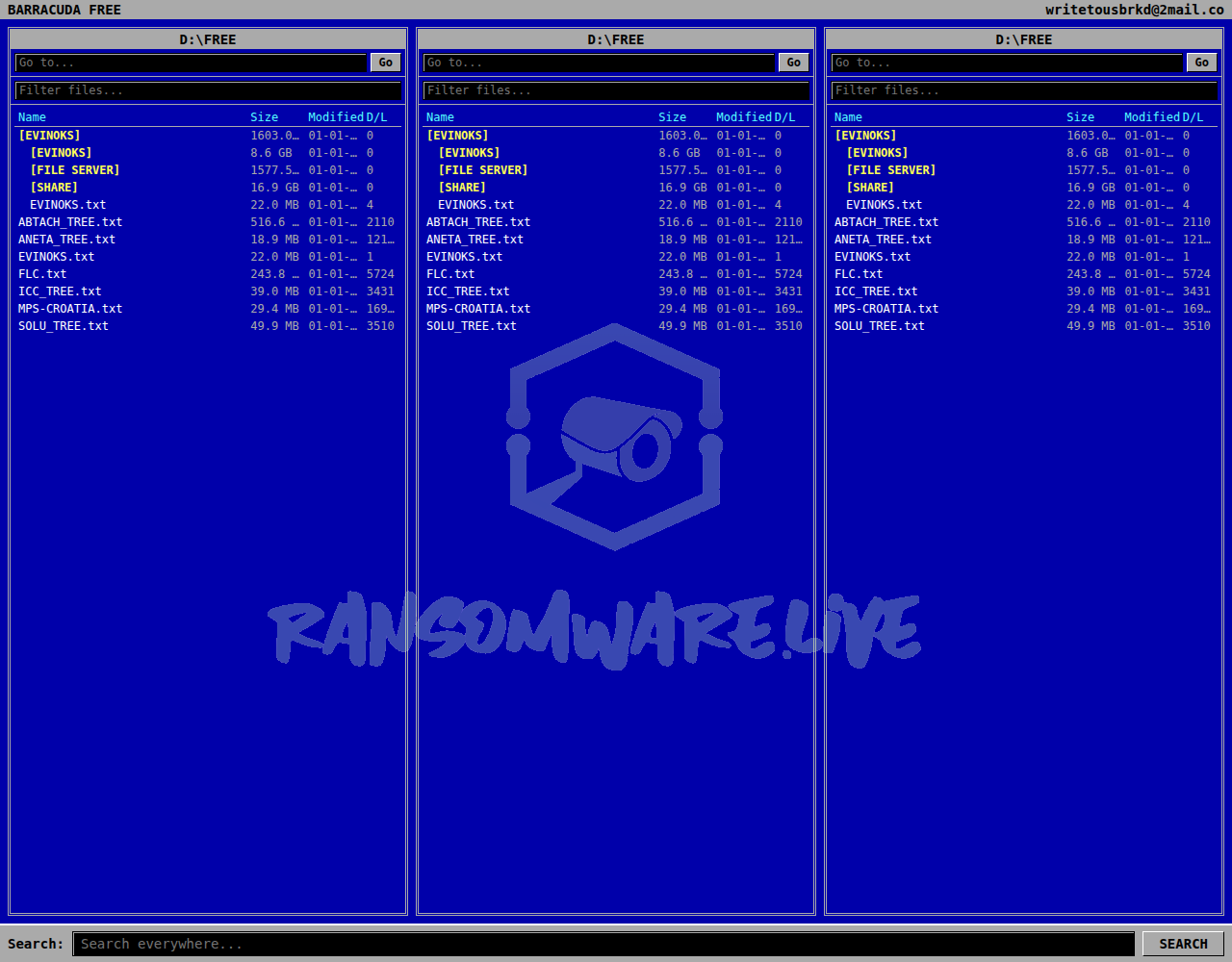
Ransomware.live recorded Dallas Theological Seminary (dts.edu, United States, Education) as a victim of the Barracuda group, discovered 2026-11-20 11:51 UTC with an estimated attack date of the same day. The group's posting opens by stating that a 'security audit' identified critical infrastructure vulnerabilities leading to a 'complete compromise', and claims 519 GB of sensitive data was stolen. It asserts the organization refused to cooperate and did not resolve the incident, that the vulnerabilities remain open, that employees and students are endangered, and that a future leak is expected. The entry is marked as published for free, meaning the data is offered publicly rather than behind a paywall. Ransomware.live captured a screenshot of the leak-site post. None of these attacker claims are independently verified, and neither the victim page nor the group page names any exploited vulnerability, malware family, tooling or TTPs.
Barracuda (not related to the security vendor Barracuda Networks, nor to the separate 'kittykatkrew' group covered on the vendor's blog) is a comparatively new leak-site operation. Ransomware.live shows its first victim with an estimated attack date of 2026-08-05 and 20 listed victims as of 2026-11-20 (5 in November), 11 countries, and 5.9 TB of leaked data reported across 12 victims. Top sectors are technology, manufacturing and healthcare; the average attack-to-claim delay is one day. The leak site is an onion service listed as online on 2026-11-20, and the group page lists a contact email address (writetousbrkd@2mail.co) as its only IOC. Other claims by the group use similar language, for example 'complete database dumps' from the Croatian Ministry of Agriculture and '1.23 TB from ProLiant main file server'. Barracuda's public posts emphasize data theft and publication; the sources reviewed do not state that files were encrypted.
The ransomware.live page also surfaces third-party exposure telemetry for dts.edu: HudsonRock reports 4 compromised employees, 789 compromised users and 1 third-party employee credential (102 indexed exposed-credential URLs externally), and ParanoidLab reports 3,778 passwords (36 critical) and 578 cookies (7 critical). This telemetry is a correlation lead for defenders (credential-based access is plausible) but is NOT evidence of how the claimed compromise occurred. DNS data shows the domain uses Microsoft 365 mail (MX dts-edu.mail.protection.outlook.com) and a broad SaaS footprint. Severity is analyst-assigned (HIGH) based on the claimed volume of stolen data and public leak. Defenders at similar institutions should treat the group's 'security audit' framing as an extortion narrative, review external attack surface and credential exposure, and monitor for the leak-site content.
MITRE ATT&CK techniques by tactic:
Collection
Initial Access
T1078 Valid Accounts; T1190 Exploit Public-Facing Application
Exfiltration
T1567 Exfiltration Over Web Service
Impact
Remediation
Immediate actions
- Force password resets and session/token revocation for accounts appearing in infostealer exposure data for dts.edu-style domains; invalidate exposed cookies
- Review external attack surface and patch internet-facing systems; check for unexpected remote access or large outbound transfers
- Monitor the group's leak site and ransomware trackers for published data and notify affected students, employees and donors per applicable law
- Block and alert on the contact email and leak-site indicators in threat-intel tooling
Workarounds
- No CVE is associated; vulnerabilities claimed by the group are unspecified
Longer-term hardening
- Enforce phishing-resistant MFA on Microsoft 365 and all SaaS applications
- Deploy EDR and infostealer-exposure monitoring with automated credential rotation
- Implement egress monitoring and data-loss-prevention for large exfiltration events
- Maintain tested offline backups and an incident response plan covering data-extortion-only scenarios
Affected and fixed versions
- Dallas Theological Seminary — Organization IT environment (dts.edu) – claimed compromise, unverified
Timeline
- Ransomware.live records the estimated attack date of the Barracuda group's first listed victims (Micro-Comm Inc., Namyang NEXMO, Skyline Implants).
- First Barracuda victims appear on its onion leak site, including Micro-Comm Inc., Namyang NEXMO and RS Automation (per Ransomware.live and SOCRadar).
- Barracuda lists Clinical Associates of the Finger Lakes, Skyline Implants & Periodontics and Namyang Industrial.
- Turkey-based technology company i2i-systems is listed as a Barracuda victim.
- Croatian Ministry of Agriculture, Forestry and Fisheries (locked-ioc-7) listed with a claim of complete database dumps.
- ProLiant (US, Technology) listed with a claim of 1.23 TB stolen from its main file server.
- Ransomware.live queries HudsonRock/ParanoidLab exposure data for locked-ioc-8 at 13:59 UTC: 789 compromised users, 3,778 exposed passwords, 578 cookies.
- Dallas Theological Seminary (locked-ioc-8) discovered on the Barracuda leak site at 11:51 UTC; group claims 519 GB stolen and published for free.
Sources cited
- Ransomware.live victim entry: Dallas Theological Seminary (Barracuda) ransomware.live · Research · 2026-11-20
- Ransomware.live group profile: Barracuda ransomware.live · Research · 2026-11-20
- Ransomware.live leak screenshot for Dallas Theological Seminary images.ransomware.live · Research · 2026-11-20
- SOCRadar: Barracuda ransomware group profile socradar.io · Research · 2026-11-20
- BreachSense: Barracuda ransomware group breachsense.com · Research · 2026-08-16
- Barracuda Networks blog: Leak sites – a field guide (what leak-site claims are worth) blog.barracuda.com · Blog · 2026-08-25
- SOCRadar: Clinical Associates of the Finger Lakes data breach (Barracuda) socradar.io · News · 2026-08-23
- SOCRadar: i2i-systems data breach (Barracuda) socradar.io · News · 2026-09-13
Drafted by the Threadlinqs research pipeline from 8 sources; published ; last updated —.